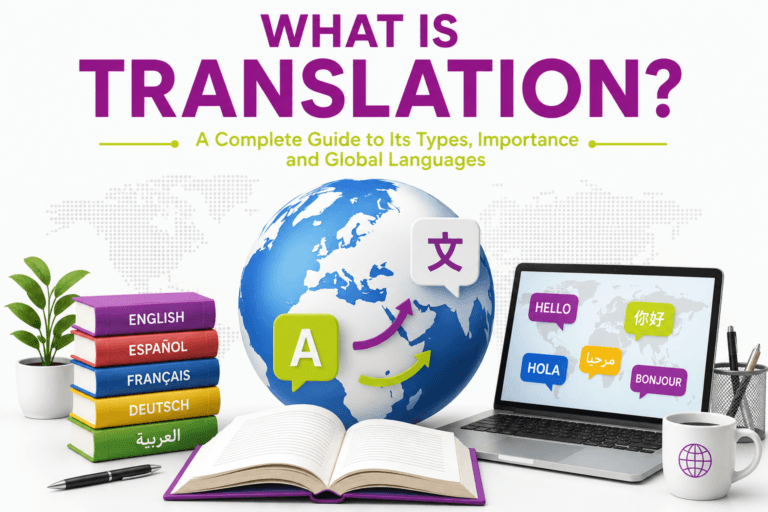
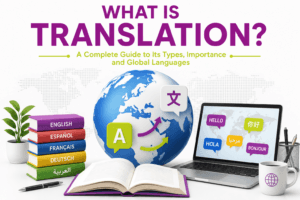
 Translation connects languages, cultures, businesses, and people across the world.
What Is Translation? A Complete Guide to Its Types, Importance and Global Languages
What is translation? Translation is the process of transferring the meaning of written content from one language, known as the source language, into another language, known as the target language.
However, translation is much more than replacing one word with another. A professional translator must understand the meaning, context, terminology, tone, culture, and purpose of the original content. The same message should then be communicated naturally and accurately to the target audience.
For example, a legal contract, medical report, website, technical manual, or marketing campaign cannot always be translated word for word. Instead, the translation must communicate the intended meaning while considering the linguistic and cultural expectations of the target audience.
Today, translation helps businesses, governments, healthcare organizations, educational institutions, researchers, and individuals communicate across language barriers. As international communication continues to grow, professional translation has become an important part of global business and communication.
What Is Translation and How Does It Work?
To understand what is translation, it is useful to look at the basic process. A translator first understands the source content and then communicates its meaning in the target language.
The process normally involves understanding the original message, researching relevant terminology, considering the target audience, translating the content, and reviewing the final text for accuracy and consistency.
Therefore, effective translation focuses on meaning rather than simply replacing individual words. The final content should be clear, accurate, and appropriate for the intended audience.
Translation vs. Interpretation: What Is the Difference?
Translation and interpretation are often used interchangeably. However, they are different language services.
Translation
Translation generally deals with written content. A translator works with written text and converts it from one language into another while maintaining accuracy, meaning, terminology, and style.
Common examples of translated content include:
- Contracts and agreements
- Certificates and official documents
- Websites and online content
- Books and publications
- Technical manuals
- Medical reports
- Business documents
- Marketing materials
- Academic papers
Interpretation
Interpretation focuses primarily on spoken communication. An interpreter helps people communicate between languages during live or real-time conversations.
Interpretation may be required for:
- Business meetings
- Conferences and events
- Legal proceedings
- Medical consultations
- Training sessions
- Interviews
- Virtual meetings
- International events
Depending on the requirements of the project, interpretation may be consecutive, simultaneous, remote, or provided on-site.
What Are the Different Types of Translation?
Translation is a broad field. Different documents require different linguistic skills, subject knowledge, terminology, and quality-control processes. Below are some of the most common types of translation services.
1. General Translation
General translation involves everyday content that does not require highly specialized technical, medical, or legal knowledge. Examples include letters, emails, general documents, news articles, informational content, and personal documents.
Although general translation may appear simple, accuracy and cultural understanding are still important.
2. Legal Translation
Legal translation involves documents related to law, regulations, contracts, and legal proceedings. Common examples include contracts, agreements, court documents, immigration documents, powers of attorney, legal notices, terms and conditions, and corporate documents.
Legal terminology must be handled carefully because even a small error may change the meaning of a document.
3. Medical Translation
Medical translation requires experience with healthcare and medical terminology. This type of translation may include medical reports, clinical trial documents, patient information, pharmaceutical documents, medical device manuals, consent forms, and healthcare websites.
In this field, accuracy is particularly important because medical information must be communicated clearly and correctly.
4. Technical Translation
Technical translation focuses on specialized documents used in industries such as engineering, manufacturing, information technology, energy, and telecommunications.
Typical documents include user manuals, installation guides, technical specifications, engineering documents, safety instructions, product documentation, and software documentation.
Technical translators must understand industry-specific terminology and maintain consistency throughout the project.
5. Business and Financial Translation
Businesses operating internationally often need documents translated for clients, partners, investors, and government authorities.
Business and financial translation may include:
- Company profiles
- Financial reports
- Annual reports
- Business proposals
- Presentations
- Market research
- Investment documents
- Corporate communications
As a result, professional translation can help organizations communicate more clearly in international markets.
6. Certified Translation
Certified translation may be required when translated documents need to be submitted to an official authority, institution, university, court, immigration department, or another organization.
These documents may include birth certificates, marriage certificates, educational certificates, diplomas, transcripts, police certificates, immigration documents, and legal documents.
Certification requirements can vary depending on the country and the organization receiving the translation.
7. Website Translation and Localization
Website translation helps businesses make their digital content accessible to international audiences. However, international expansion may require more than direct translation.
This is where localization becomes important. Localization adapts content to the language, culture, preferences, formats, and expectations of a specific market.
Localization may involve adapting:
- Dates and time formats
- Currency
- Units of measurement
- Images
- Cultural references
- Idioms and expressions
- Tone of communication
- Product information
Therefore, website localization can help create a more natural experience for users in different countries.
8. Software and App Localization
Software localization involves adapting digital products for users in different languages and markets. It may include software interfaces, mobile applications, user interfaces, error messages, help documentation, buttons, menus, and notifications.
The translated content must also meet technical requirements such as character limits and software formatting.
9. Marketing Translation and Transcreation
Marketing content cannot always be translated word for word. A slogan or advertising message that works well in one country may not have the same impact in another language.
Transcreation combines translation with creative adaptation. Its objective is to preserve the intended message, emotion, and marketing impact.
Marketing translation may include advertising campaigns, brand messaging, social media content, brochures, product descriptions, slogans, and promotional websites.
10. Audiovisual Translation
Audiovisual translation is used for video and multimedia content. Common examples include subtitles, video translation, dubbing, voice-over, e-learning content, training videos, films, and documentaries.
As global video content continues to grow, audiovisual translation can help organizations communicate with audiences in multiple languages.
Why Is Translation Important?
Translation plays an important role in connecting people, businesses, and communities. The world contains thousands of languages, and not everyone communicates in the same language.
For this reason, translation helps reduce communication barriers and makes information more accessible to different audiences.
Translation Helps Businesses Expand Internationally
A company may have an excellent product or service, but potential customers may not understand its website, marketing materials, product information, or customer support if everything is available in only one language.
Translation can help businesses communicate with customers in their preferred language. This may include translating websites, product information, marketing campaigns, technical documentation, customer communications, and legal documents.
Translation Improves Access to Information
People need access to important information in a language they understand. This is particularly important in healthcare, education, government services, immigration, legal services, and public safety.
Accurate translation can make important information more accessible to multilingual communities.
Translation Supports International Trade
International businesses regularly exchange contracts, specifications, financial documents, product information, and other important materials.
Professional translation can help organizations communicate with suppliers, distributors, customers, and business partners across different countries.
Translation Supports Education and Research
Students, universities, researchers, and academic institutions frequently work with information published in different languages.
Translation makes research, educational materials, scientific knowledge, and academic content accessible to a wider audience.
Translation Connects Cultures
Language is closely connected to culture. A professional translator must consider context, cultural references, tone, and the intended audience.
As a result, translation allows ideas, literature, knowledge, and experiences to move between different cultures and communities.
How Many Languages Are Spoken Around the World?
The world is highly linguistically diverse. More than 7,000 spoken or signed languages are used around the world.
However, some languages are spoken by significantly larger populations and play an important role in international business, technology, education, diplomacy, and global communication.
The number of speakers can vary depending on whether statistics count only native speakers or both native and second-language speakers.
The World’s Most Widely Spoken Languages
The following figures are approximate total speaker estimates and may change over time depending on the methodology used.
| Language | Approximate Number of Speakers | Major Regions |
|---|---|---|
| English | About 1.5 billion | Worldwide |
| Mandarin Chinese | About 1.18 billion | China, Taiwan and global communities |
| Hindi | About 611 million | India and international communities |
| Spanish | About 558 million | Spain, Latin America and the United States |
| Arabic | About 335 million | Middle East and North Africa |
| French | About 312 million | Europe, Africa, Canada and other regions |
| Bengali | About 284 million | Bangladesh and India |
| Portuguese | About 267 million | Brazil, Portugal, Africa and other regions |
| Russian | About 253 million | Russia, Eastern Europe and Eurasia |
| Indonesian | About 252 million | Indonesia |
| Urdu | About 246 million | Pakistan, India and global communities |
| German | About 134 million | Germany, Austria, Switzerland and Europe |
| Japanese | About 126 million | Japan and international communities |
These languages represent important opportunities for businesses and organizations that want to communicate with international audiences.
Why Do Businesses Need Translation in Multiple Languages?
Businesses today can reach customers far beyond their home country. For example, a company may work with clients, suppliers, partners, or customers across Europe, Asia, the Middle East, Africa, and Latin America.
Professional translation can help organizations:
- Enter new international markets
- Communicate with customers
- Translate legal and business documents
- Localize websites
- Support multilingual employees
- Provide product documentation
- Meet regulatory requirements
- Improve the international customer experience
The language requirements of every project are different. For example, a legal translation may require specialist terminology, while a marketing campaign may require cultural adaptation and creative writing.
Therefore, translation projects are often matched with linguists who have relevant language and industry expertise.
The Translation Process: How Does Professional Translation Work?
Although the process may vary depending on the project, professional translation usually involves several important stages.
1. Understanding the Project
The translation provider reviews the document, language combination, subject matter, formatting requirements, and deadline.
2. Selecting the Right Translator
The project is assigned to a qualified linguist with relevant language and subject expertise.
3. Translation
The translator converts the source content into the target language while maintaining the original meaning and purpose.
4. Editing and Proofreading
The translated content may be reviewed for:
- Grammar
- Spelling
- Terminology
- Consistency
- Formatting
- Accuracy
5. Quality Control
Additional quality checks may be performed depending on the requirements of the project.
6. Final Delivery
The completed translation is delivered in the required format, which may include Word, PDF, Excel, PowerPoint, website files, design files, or other formats.
Human Translation, Machine Translation and AI
Technology has changed the translation industry significantly. Machine translation and AI-powered tools can be useful for understanding basic content, handling simple communication, and improving productivity.
However, complex projects may still require professional human review. This is particularly important when accuracy, specialized terminology, cultural adaptation, legal implications, medical information, or brand communication are involved.
Human translators can consider context, cultural meaning, audience expectations, and the specific purpose of the content.
Therefore, technology and human expertise can work together as part of an efficient translation workflow.
Choosing the Right Translation Service Provider
When selecting a translation company or language service provider, consider the following factors:
- Native or highly qualified linguists
- Subject-matter expertise
- Quality assurance processes
- Confidentiality and data protection
- Translation technology
- Professional project management
- Ability to handle multiple languages
- Editing and proofreading support
- DTP and formatting capabilities
- Reliable turnaround times
The right translation solution depends on the type of document, language combination, industry, target audience, and purpose of the project.
Professional Translation Services by Lingvopedia
Lingvopedia provides professional language solutions for businesses, organizations, and individuals requiring communication across languages and cultures.
Our language services include:
- Document translation
- Legal translation
- Medical translation
- Technical translation
- Business translation
- Certified translation
- Website translation
- Localization
- Editing and proofreading
- DTP and typesetting
- Language interpretation
- Translator and interpreter recruitment
We work with qualified language professionals to support multilingual communication across a wide range of industries and language combinations.
Whether you need to translate a single document or manage a multilingual project involving multiple languages, the right translation process can help ensure that your message is communicated accurately and effectively.
Frequently Asked Questions About Translation
What is translation in simple words?
Translation is the process of converting the meaning of written content from one language into another while maintaining accuracy, context, and the intended message.
What is the difference between translation and interpretation?
Translation generally deals with written content, while interpretation focuses on spoken communication.
How many types of translation are there?
There are many types of translation, including legal, medical, technical, business, financial, certified, website, marketing, audiovisual, and literary translation.
Why is professional translation important?
Professional translation helps ensure that meaning, terminology, context, and cultural relevance are accurately communicated to the target audience.
What is localization?
Localization is the process of adapting content for a specific country, region, culture, or audience. It may include changes to language, currency, dates, images, cultural references, and other elements.
Can AI replace human translators?
AI and machine translation tools can be useful for certain tasks. However, human expertise remains important when context, cultural adaptation, specialized terminology, accuracy, or high-stakes communication are involved.
Need Professional Translation Services?
Effective communication should not be limited by language barriers. Whether you require translation, editing, proofreading, localization, DTP typesetting, interpretation, or multilingual language support, Lingvopedia can help you find the right solution for your project.
Contact Lingvopedia today to discuss your translation requirements and request a free quotation.
Learn More About Languages and Translation
To explore more information about languages and global linguistic diversity, you can visit the following resources: